The ultimate focus of Human Resources is people, and NLP is essentially “the user’s manual for the mind.” This workshop aims to transform HR leaders from traditional process and problem-solvers into organisational “Communication influencer,” “Motivator,” and “Change Specialist.” By enhancing their internal state and external influence, they can drive the energy and potential of the organisation’s talent.
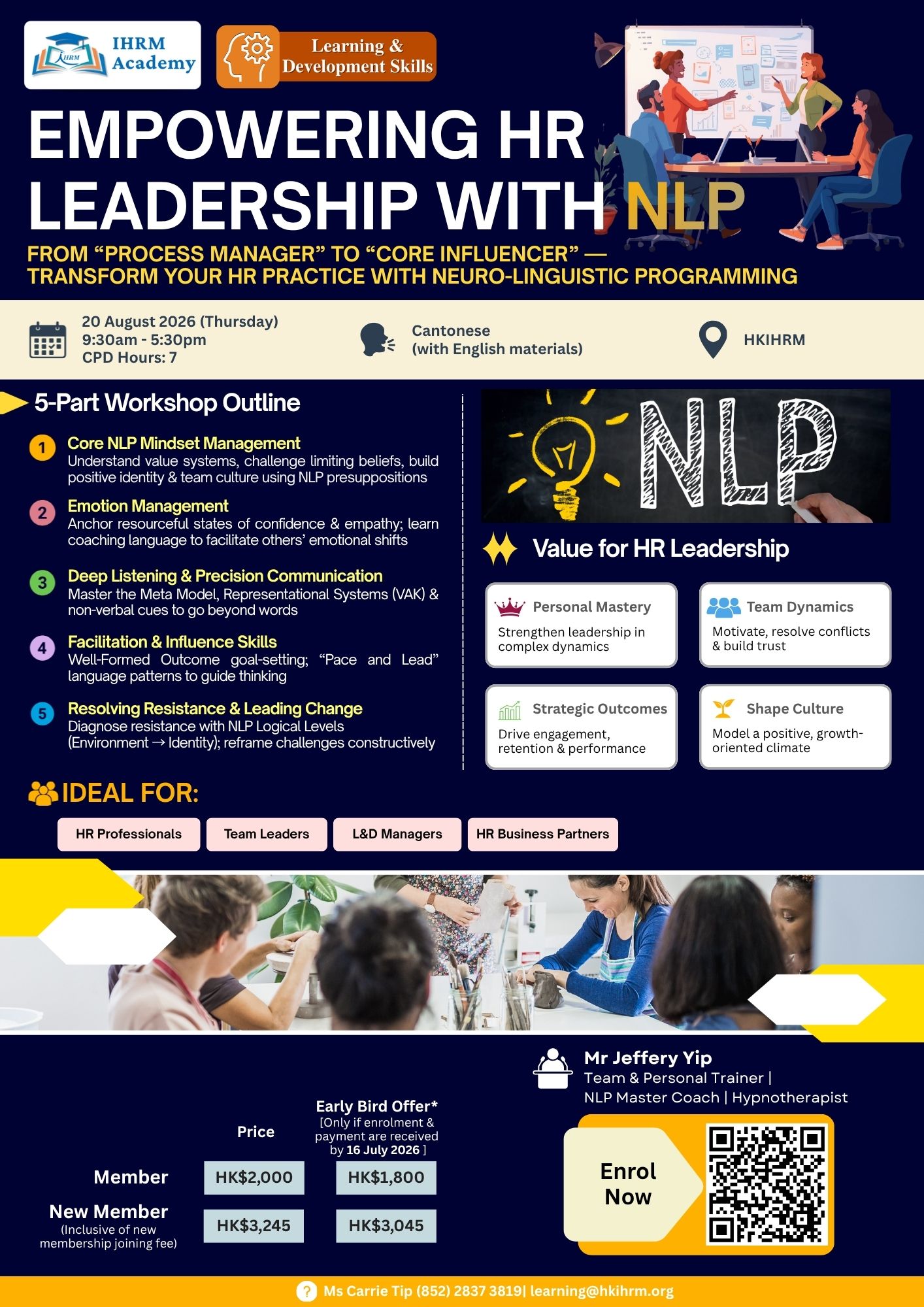
Part 1: Core NLP Mindset Management
Understanding People Value in conversation:
Learning to quickly access people value system in recruitment or in meeting, knowing their motivation factor, so that we can have better understanding how to
– Learn what is value System
– The factor of motivation, layers and direction
– How to understand self and others value system by questioning and talking
Belief System and Reframing:
Identifying and challenging limiting beliefs (e.g., “Employees always resist change,” “We can’t retain top talent”).
Installing empowering beliefs (e.g., “Change is an opportunity for growth,” “I have the ability to create an environment that attracts talent”).
– How a belief is created in organisation
– How to recreate a positive belief in team and Group
The Role and identity in organisation:
How to facilitate people to have a clear and positive identity in the team, how to position themselves and understand their value to contribute. Have a clear self identity have people have a positive attitude in the organisation.
How to build up a positive culture and facilitate change :
NLP talk about mindset system, when we building a team or managing a team, how to build a positive culture and mindset is an important process. NLP have some mindset presupposition which is helpful on building positive team culture.
Part 2: Emotion Management – Becoming a Resourceful & Resilient HR Leader
Anchoring an Excellent State:
Learning to quickly access and maintain a resourceful state of “confidence, neutrality, and empathy” before difficult conversations (conflict mediation, executive negotiations).
Creating personal “state triggers” to manage high-pressure situations.
How to facilitate others emotion and state :
Some of the coaching skill and language pattern is helpful to clam down people and help to shift negative emotion to neutral state. So when we are doing mediation d
Part 3: Deep Listening & Precision Communication – Going Beyond Words
The Three Pillars of NLP Communication:
Language Patterns (The Meta Model): Using questions to clarify deletions, distortions, and generalizations in employee speech to obtain accurate information. (e.g., When an employee says, “Everyone is unhappy,” ask: “Specifically, who is unhappy about what?”)
Sensory-Based Language (Representational Systems):
Identifying an employee’s preferred communication channel (Visual, Auditory, Kinesthetic) and speaking their “native language” to build deep rapport.
Non-Verbal Cues: Interpreting tone, posture, and breathing to discern the true message beyond words.
Part 4: Facilitation & Influence Skills – Unleashing Employee Potential
Goal-Setting Framework (Well-Formed Outcome): Using the NLP outcome framework to coach employees or departments in setting clear, achievable, and ecological performance and development goals.
Artful Language Patterning: Learning to use “Pace and Lead” language patterns—first acknowledging the other’s emotional state, then guiding them toward new ways of thinking.
Part 5: Resolving Resistance & Leading Organizational Change
Understanding the Levels of Resistance (NLP Logical Levels): At which level is an employee resisting change?
Environment (Where/When?) → Behavior (What?) → Capabilities (How?) → Beliefs/Values (Why?) → Identity (Who?) → Purpose (For whom/For what greater good?)
Case Application: When facing resistance to a new performance system, diagnose whether it stems from “not knowing how to use it” (Capability level) or believing “it’s unfair” (Belief level), and apply the corresponding strategy.
Reframing: Helping employees and management view change and challenges through a more positive, constructive lens.