Five Questions Every Leader Should Ask Themselves
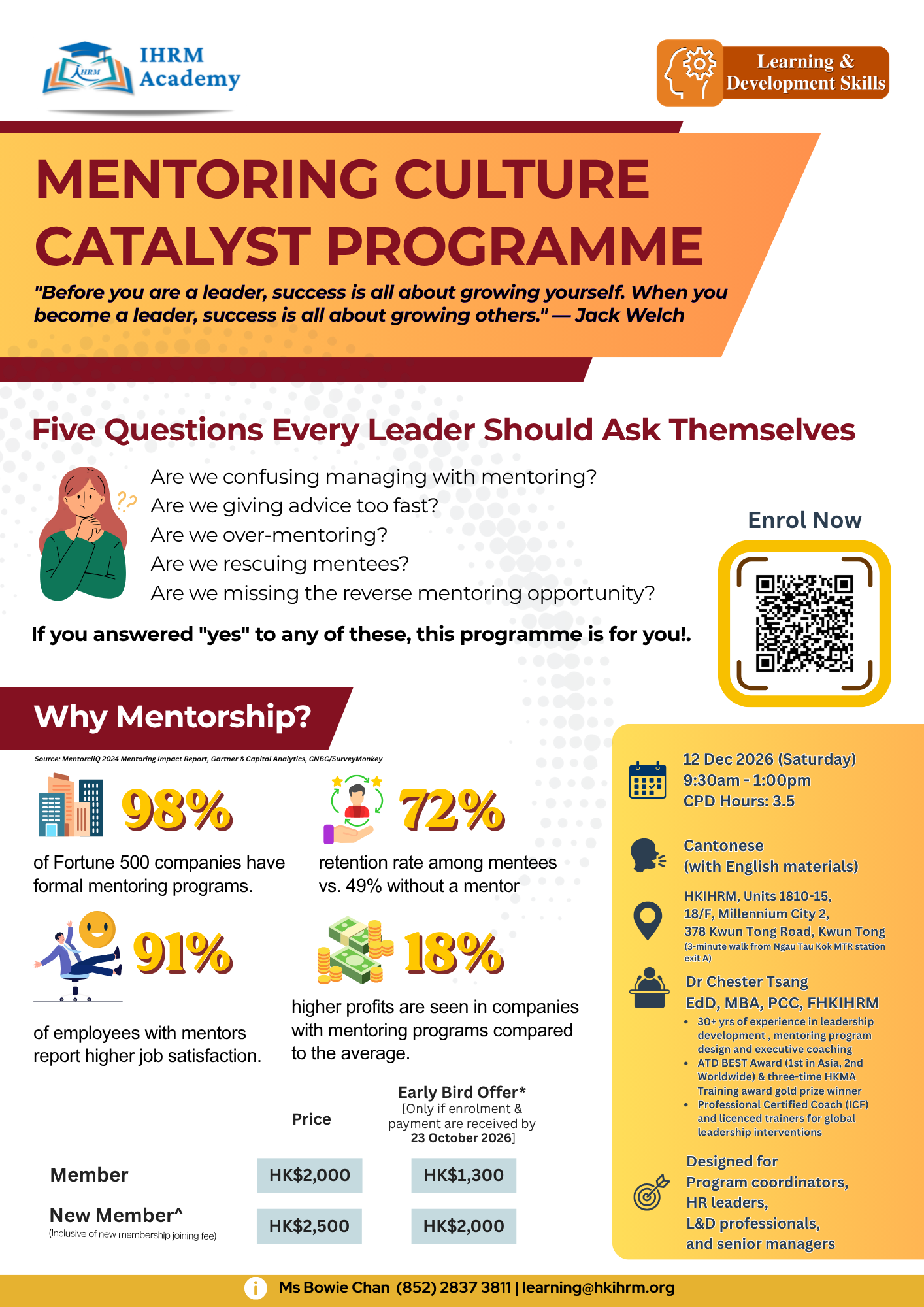
- Are we confusing managing with mentoring – treating mentees like direct reports instead of developmental partners?
- Are we giving advice too fast – solving problems instead of building capability?
- Are we over‑mentoring – sharing long stories that take over the conversation instead of handing back control?
- Are we rescuing mentees – stepping in to fix things instead of trusting their ability to figure it out?
- Are we missing the reverse mentoring opportunity – failing to learn from junior talent about AI, digital trends, and new workplace norms?
Why Mentorship? The Research
Source: MentorcliQ 2024 Mentoring Impact Report, Gartner & Capital Analytics, CNBC/SurveyMonkey
- 98% of Fortune 500 companies have formal mentoring programs.
- 72% retention rate among mentees vs. 49% without a mentor.
- 91% of employees with mentors report higher job satisfaction.
- Companies with mentoring programs see profits 18% better than average.
Programme Objectives
By the end of this half‑day masterclass, you will be able to:
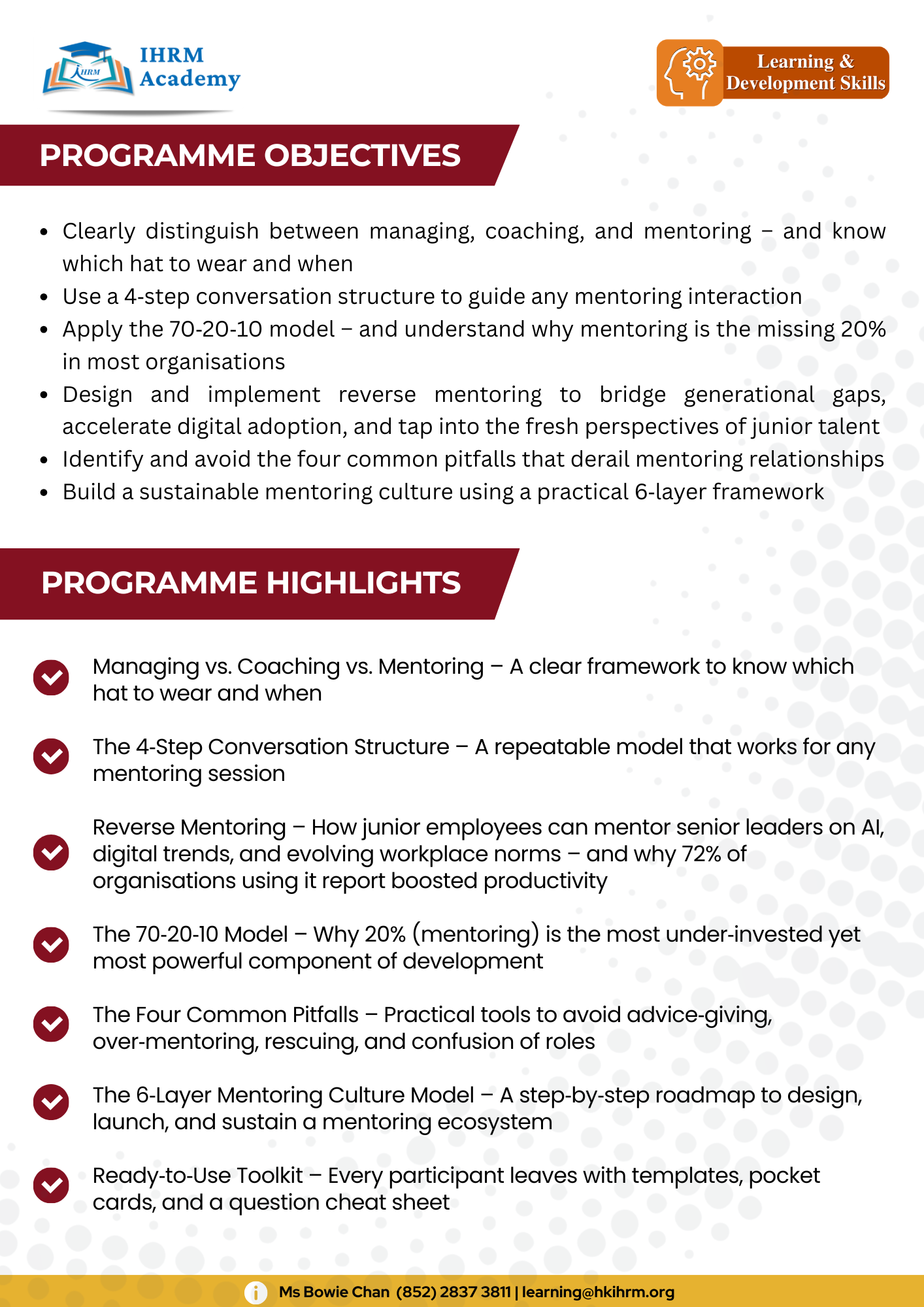
- Clearly distinguish between managing, coaching, and mentoring – and know which hat to wear and when
- Use a 4‑step conversation structure to guide any mentoring interaction
- Apply the 70‑20‑10 model – and understand why mentoring is the missing 20% in most organisations
- Design and implement reverse mentoring to bridge generational gaps, accelerate digital adoption, and tap into the fresh perspectives of junior talent
- Identify and avoid the four common pitfalls that derail mentoring relationships
- Build a sustainable mentoring culture using a practical 6‑layer framework
Programme Highlights
- Managing vs. Coaching vs. Mentoring – A clear framework to know which hat to wear and when
- The 4‑Step Conversation Structure – A repeatable model that works for any mentoring session
- Reverse Mentoring – How junior employees can mentor senior leaders on AI, digital trends, and evolving workplace norms – and why 72% of organisations using it report boosted productivity
- The 70‑20‑10 Model – Why 20% (mentoring) is the most under‑invested yet most powerful component of development
- The Four Common Pitfalls – Practical tools to avoid advice‑giving, over‑mentoring, rescuing, and confusion of roles
- The 6‑Layer Mentoring Culture Model – A step‑by‑step roadmap to design, launch, and sustain a mentoring ecosystem
- Ready‑to‑Use Toolkit – Every participant leaves with templates, pocket cards, and a question cheat sheet
Target Group
This programme is designed for program coordinators, HR leaders, L&D professionals, and senior managers responsible for:
- Designing and implementing mentoring programmes
- Fostering a mentoring culture within their organisation
- Developing leadership pipelines and retaining talent
- Integrating mentoring into broader talent development strategies