Course Objectives:
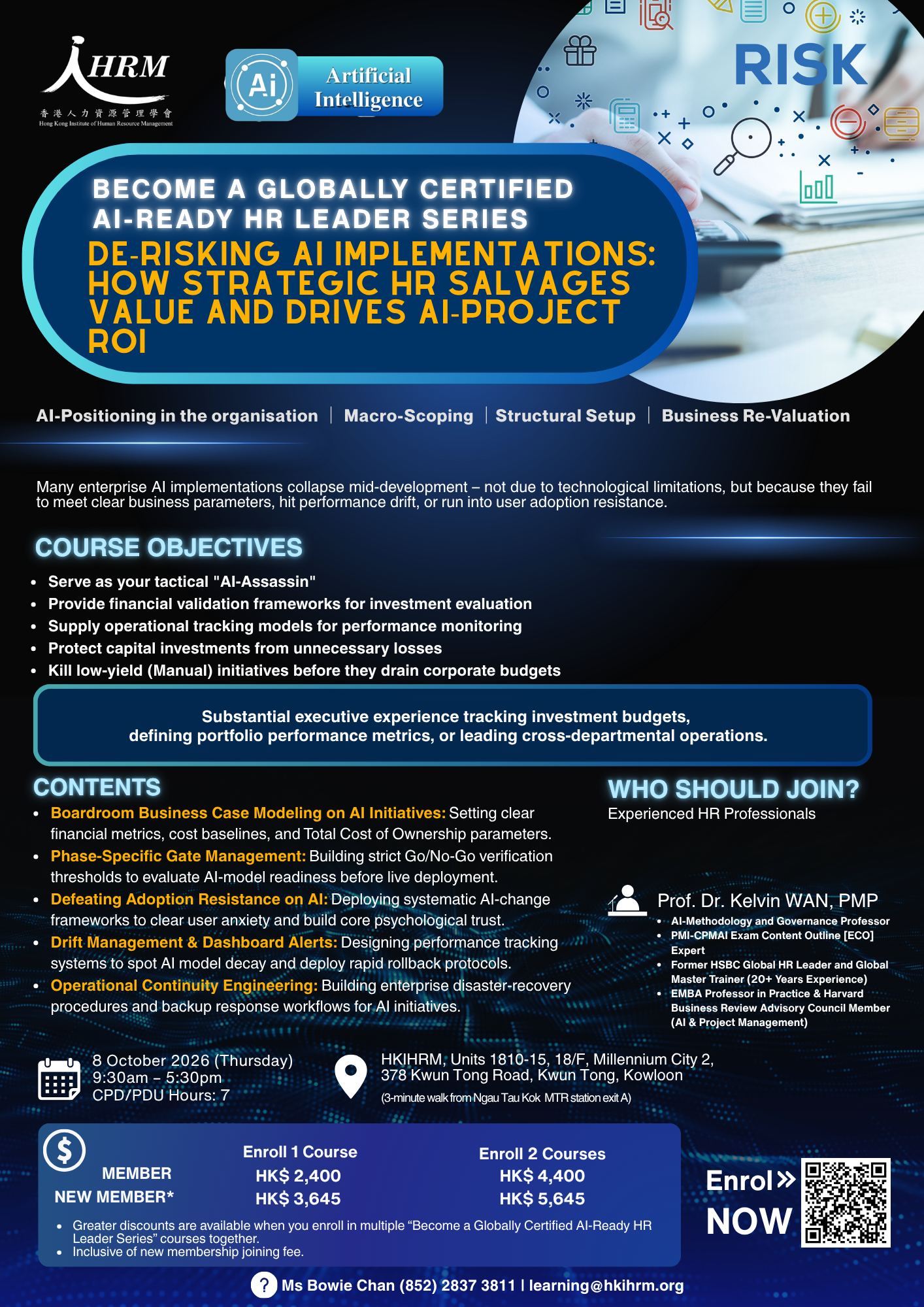
- Serve as your tactical “AI-Assassin”
- Provide financial validation frameworks for investment evaluation
- Supply operational tracking models for performance monitoring
- Protect capital investments from unnecessary losses
- Kill low-yield (Manual) initiatives before they drain corporate budgets
Contents:
- Boardroom Business Case Modeling on AI Initiatives: Setting clear financial metrics, cost baselines, and Total Cost of Ownership parameters.
- Phase-Specific Gate Management: Building strict Go/No-Go verification thresholds to evaluate AI-model readiness before live deployment.
- Defeating Adoption Resistance on AI: Deploying systematic AI-change frameworks to clear user anxiety and build core psychological trust.
- Drift Management & Dashboard Alerts: Designing performance tracking systems to spot AI model decay and deploy rapid rollback protocols.
- Operational Continuity Engineering: Building enterprise disaster-recovery procedures and backup response workflows for AI initiatives.
You may want to know:
1. What global and local frameworks is the course content based on?
The curriculum is engineered as a top-tier, vendor-neutral framework tailored for enterprise-grade deployment. It seamlessly integrates international governance metrics with local regulatory standards, built directly upon:
- HKSAR Digital Policy Office (DPO) Ethical AI Framework, directly supporting the government’s strategic focus on the “AI+” national talent strategy and public service digital transformation.
- International Standard Organization ISO42001 (AI Management Systems) Standards for AI-governance,
- National Institute of Standards and Technology (NIST) AI Risk Management Standards and framework for management
- AI Governance Professional (AIGP) Principles, and
- Certified Professional in Managing AI (CPMAI) Exam Content Outline [ECO].
2. Why this course for HRBP / Working HR Professionals?
In the modern enterprise, business units are moving rapidly to deploy autonomous workflows and independent AI agents. However, if HR remains structurally disconnected from this core architectural design, organisations will face immediate compliance liabilities, algorithmic bias, and destructive workforce fragmentation. To eliminate these critical operational vulnerabilities, this program directly bridges the gap between traditional human resource wisdom and high-stakes technology management, officially positioning HR as the ultimate architect of a defensible, AI-enabled business.
3. After taking this instructor-led live course, am I ready to take the Exam CPMAI?
There are some steps. Besides good understanding of CPMAI Methodology, you have to follow the step stated in “Your Steps to Certification” session of PMI.org website, in order to sit for the public exam in Hong Kong.
https://www.pmi.org/certifications/ai-project-management-cpmai#steps
4. After taking this course, is my organization ready to get ISO42001 certified?
There are some steps. Besides good understanding ISO42001, you have to follow the steps stated in this website: https://www.iso.org/standard/42001
5. After taking this course, am I eligible to take the NIST exam to get certified?
There are some steps. Besides, good understanding of AI Risk Management Framework, you have to follow the steps stated in this website: https://www.nist.gov/artificial-intelligence
6. After taking this course, am I eligible to take AIGP exam to get certified?
You can get more info from: https://iapp.org/certify/aigp