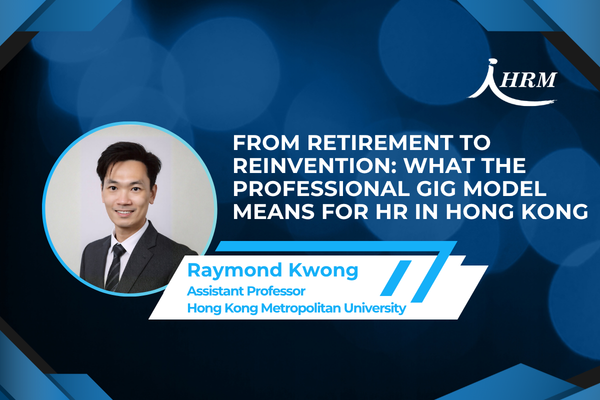
From Retirement to Reinvention: What the Professional Gig Model Means for HR in Hong Kong
Three Key Takeaways
1. Hong Kong already has retirees who are willing to contribute and employers who are open to engaging them, but practical pathways remain underdeveloped.
2. The Professional Gig model works best when employers redesign experience intensive tasks into clear, manageable, and well defined assignments.
3. HR professionals can play a central role by improving matching, piloting suitable roles, and setting clear expectations for both organisations and retirees.
Hong Kong’s labour market is being reshaped by two challenges at the same time. The first is rapid population ageing. The second is the continued demand for experience, professional, and specialist knowledge in many organisations. For HR practitioners, this creates an important question. Can retired professionals continue contributing in ways that are flexible, useful, and realistic for later life?
A recent study by Hong Kong Metropolitan University suggests that the answer is yes, but only if employers move beyond conventional hiring assumptions and rethink how work is structured.
Understanding the Professional Gig model
Professional Gig model refers to arrangements in which retirees contribute professional expertise through flexible and clearly bounded job roles. This is not casual work, nor is it simply ordinary part time employment. The central idea is that the retiree is not expected to step back into the same broad role previously held. Instead, the organisation identifies where experience matters most and redesigns that part of the work into a more focused and manageable assignment.
What the study found
Among retirees surveyed, 23.4% were already engaged in paid work after retirement. Another 21.4% were classified as mobilisable, meaning that they were interested in working and had already taken concrete steps, but had not yet returned to paid work. On the employer side, 33.0% were already active adopters of retiree Professional Gig arrangements, while 25.9% were open to the model but had not yet implemented it.
These findings show that both supply and demand already exist. The central challenge lies in converting this partial readiness into arrangements that are workable, credible, and sustainable.
The study also found that retirees are not motivated by income alone. Many respondents associated this form of work with continued contribution, social connection, mental stimulation, and the opportunity to pass on knowledge and experience. For employers, this means that retirees should not be viewed simply as a source of extra labour. They should be understood as a source of experience-based value.
Table 1. Selected findings with direct relevance to HR
Finding | Relevance for HR |
23.4% of retirees were already in paid work after retirement | There is already an active pool of retiree talent |
21.4% of retirees were mobilisable | A sizeable group may respond if suitable job roles are available |
33.0% of employers were already active adopters | The model is already being used in practice |
25.9% of employers were open but inactive | There is strong potential for conversion through better support |
Why HR should pay attention
For HR professionals, the key issue is not only recruitment but also job role design. Many organisations begin by asking whether a retiree can return to a previous full-time position. That is often the wrong question. A more useful question is which parts of the work truly require experience, mentoring, review, or professional judgement. Once those parts are identified, they can often be reorganised into a role that is more appropriate for later life participation.
This is where HR can make a distinctive contribution. The task is not simply to find retirees. It is to redesign work in ways that allow organisations to capture the value of experience more effectively.
A practical roadmap for organisations
The study points to four directions that have immediate relevance for HR practice:
- Build more structured matching mechanisms
Matching remains too informal in many organisations. Retirees often rely on personal networks, while employers may not know where to find suitable candidates. This is why the study recommends an official professional matching platform. Such a platform should be more than a job board. It should provide practical information, guidance on suitable role types, and examples of workable arrangements.
- Start with job role redesign rather than vacancy filling
Employers should begin by identifying experience intensive tasks that can be modularised into clearer assignments. The focus should be on where judgement, mentoring, review, or specialist support is needed, rather than on replacing a full-time vacancy.
- Introduce one or two pilot roles first
A pilot approach allows organisations to test fit, clarify expectations, and learn from experience without making a large commitment at the outset. This lowers organisational risk and increases the likelihood of successful implementation.
- Use clear written arrangements
Retirees and employers are both sensitive to ambiguity. Scope of work, time commitment, deliverables, reporting lines, confidentiality, and review points should all be clearly stated from the beginning.
Table 2. From standard role to Professional Gig arrangement
Standard role | Experience intensive tasks that can be modularised | Possible Professional Gig arrangement | Likely organisational benefit |
Senior engineer | Design review, technical risk assessment, mentoring junior engineers | One to two days per week during key project stages | Better quality control and stronger capability development |
Finance or accounting manager | Audit preparation, internal control review, coaching junior staff | Engagement during reporting periods | Improved reporting quality and support for team development |
Operations executive | Process review, governance advice, management coaching | Project based advisory role | Access to senior judgement without creating a permanent post |
Conclusion
The Professional Gig model should not be treated as a symbolic ageing initiative. It is a workforce strategy with practical implications for how organisations use experience in an ageing society. For HR professionals, the significance of the model lies not only in recruitment, but in role redesign, structured matching, pilot implementation, and clear expectation management.
In a labour market where experience remains valuable, the question is no longer whether retirees can contribute. The more important question is whether organisations are prepared to use that contribution well.
Acknowledgment
This research project (Project Number: 2024.B16.013.25A) is funded by the Public Policy Research Funding Scheme of The Government of the Hong Kong Special Administrative Region (project in progress).