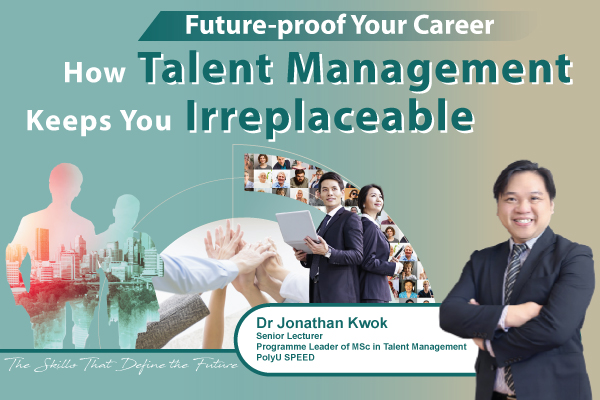
Future-proof Your Career: How Talent Management Keeps You Irreplaceable
Sponsored Article
About PolyU SPEED
- PolyU SPEED offers a diverse range of full-time and part-time undergraduate programmes and master’s degree programmes to equip aspiring individuals with advanced professional knowledge and cross-disciplinary skills. Graduates will receive a degree awarded by PolyU, one of the world’s top 100 universities.
- Its newly launched MSc in Talent Management prepares future HR leaders with strategic insight, data-driven decision-making skills, and the agility to navigate evolving workforce demands. The programme is now open for application for the September 2026 entry.
The world of work is undergoing a fundamental reconstruction. While technological shifts once changed our tools, they now redefine our very capabilities—how we think, collaborate, and create value. According to the World Economic Forum (2023), 44% of the core skills required for work will be disrupted within five years. In this climate, the central question for professionals has evolved from “How secure is my job?” to “How adaptable is my skill set?”
Knowing how to manage your own talent — learning faster than the world changes — has become the ultimate safeguard for your career. Job security no longer comes from tenure; it comes from talent intelligence.
From Job Titles to Skill Portfolios
The modern economy is shifting from rigid, role-based structures to fluid, project and skill-based work. A job title is merely a container; true value lies in the dynamic portfolio of skills you can deploy and recombine.
Career capital is now built through capabilities — creativity, data fluency, leadership, and the ability to work across disciplines. Those who invest strategically in these capabilities stay relevant even as titles evolve.
“In the age of AI, your ability to learn faster than the world changes is your competitive advantage.”
This mindset transforms talent management from an HR policy into a personal career discipline.
The Greater Bay Area: A Microcosm of Talent Evolution
Nowhere illustrates this transformation more clearly than the Guangdong–Hong Kong–Macao Greater Bay Area (GBA).
Home to roughly 86 million people and a combined GDP of nearly USD 1.9 trillion, the region is a hotbed of digital and financial innovation. Opportunities in tech, green energy, and cross‑border commerce are multiplying.
Yet employers face a paradox — there is no shortage of people, but there is a shortage of adaptable, analytics‑driven, culture‑savvy leadership talent. The city’s professionals who blend China speed + global mindset are in particularly high demand.
For individuals, this means that career resilience in the GBA depends on continuous learning, cross‑cultural agility, and the courage to reinvent oneself.
Talent Management as a Career Strategy
Most people associate talent management with HR departments — succession plans, performance reviews, and competency frameworks. But on a personal level, it’s also a career strategy anyone can apply. Consider these four dimensions:
- Self‑Awareness: Map the capabilities you currently use and those that will matter in three‑to‑five years.
- Learning Agility: Experiment, seek feedback, and absorb knowledge quickly. Agility is more valuable than mastery.
- Network Intelligence: Surround yourself with mentors, peers, and role models who expand your perspective.
- Data Mindset: Track your impact — measure outcomes, not just activity. Let evidence tell your story.
Leading companies are already embedding these principles. Tencent’s “Tencent University” platform turns learning into a daily practice, while Huawei’s “Seeds for the Future” exposes young talent to global leadership early on. Employees who emulate these behaviours — not just the job tasks — accumulate lasting career capital.
What Employers Really Value in 2026 and Beyond
Research from McKinsey and LinkedIn shows a convergence around five “power skills” for the post‑AI decade:
- Cross‑disciplinary thinking — connecting business, data, and people insight
- AI and data literacy — working with automation rather than fearing it
- Emotional intelligence — empathy, communication, and influence
- Collaboration across cultures — navigating remote and hybrid dynamics
- Adaptability and resilience — staying productive amid uncertainty
These traits differentiate humans from machines. They can’t be downloaded; they must be developed through intentional stretch experiences — taking on projects outside comfort zones, leading initiatives, or mentoring colleagues.
Becoming “Irreplaceable” — the Human Edge
When we talk about being irreplaceable, it isn’t about perfection. It’s about cultivating unique problem‑solving value.
AI can process information; it cannot interpret organisational culture or inspire a team through a crisis. Creativity, empathy, and strategic narrative remain fundamentally human.
Consider the HR manager who used data analytics to identify onboarding bottlenecks. By redesigning orientation around employee experience, she reduced first‑year attrition by 30%. Her irreplaceability came not from data analysis alone, but from connecting insight to empathy — technology informed her decisions, but emotion inspired action.
A Three‑Step Framework for Future‑proof Careers
You can’t control disruption, but you can design how you respond.
Here’s a simple framework many professionals use to self‑manage their growth:
- Awareness — audit your current skill set and the market trends shaping your field
- Action — create a personal learning sprint each quarter. Take a short course, rotate into a new project, or mentor a junior colleague
- Advancement — leverage your new capabilities to lead initiatives or share knowledge publicly
Repeat this loop consistently, and career progress becomes a rhythm rather than a race.
Education as a Growth Lever
Formal learning remains a powerful accelerant when integrated with work experience. Postgraduate programmes such as the MSc in Talent Management at PolyU SPEED blend strategic HR, leadership development, and people analytics to help professionals translate learning into measurable business value.
Participants often say the greatest benefit is not the credential itself, but the mindset shift — viewing themselves as both learners and designers of talent ecosystems.
Designing, Not Defending, Your Career
The uncertainty of modern work can feel intimidating, but it also democratises opportunity. Each disruptive wave — AI, remote work, sustainability — rewards those who adapt quickly and think holistically about talent.
Being “future‑proof” doesn’t mean resisting change. It means cultivating learning agility, strategic perspective, and human connection so that your contribution remains meaningful, regardless of technology or title.
So, ask yourself:
- Which one skill will make me more valuable this year?
- Who can I learn from or mentor next month?
- And what step will bring me closer to the future I want to shape?
You can’t control the future of work — but you can design your place in it.