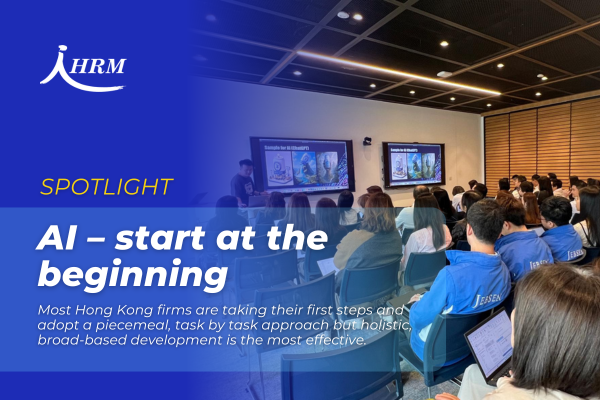
Adopting artificial intelligence in the workplace demands an all-in, deep-end approach by management and employees, not an incremental, piecemeal approach.
The Hong Kong Institute of Human Resource Management (HKIHRM) Topical Study on AI in HR showed structural changes are rare among Hong Kong firms – specifically, 70% prioritise training in AI and knowledge sharing, while 35% focus on streamlining job structures and 34% on redesigning roles for non-AI tasks. For orderly transition, priorities should be switched.
Angela Wong, Corporate Communications and Administration Director, Jebsen Group, said the firm took a first step in 2024 by embedding Microsoft Copilot into daily workflows.
“We quickly realised that success would depend not just on the tool itself, but on how we trained and engaged our people.
“That learning curve taught us the importance of tailored training and sparked a broader conversation about digital readiness.”
Wong said the following year Jebsen launched the AI Transformation Project—an initiative co-led by Group IT Director, Sean Tan and herself – reporting directly to the Group CEO.

Cultural factors
Reflecting the broad-based approach typical of AI leaders, Wong said Jebsen did not embrace AI purely for technological reasons; cultural factors came into play.
“We saw AI as a catalyst to reimagine how we work, communicate and create value across our diverse business lines. The motivation stemmed from a confluence of internal ambition and external momentum. As digital transformation accelerated globally, we recognised that AI could empower our teams to make smarter decisions, faster.”
Current initial pilots focused on enhancing operational efficiency, better customer experiences, growth and training colleagues.
Clearly Jebsen could not simply adopt a fully finished AI suite immediately. The firm has concentrated on three key areas to drive the transition forward.
First is the big one that set off the generative AI craze – Content Generation & Communications.
“One of our earliest initiatives was an intensive AI training programme for our marketing teams across all our business lines. We partnered with an external vendor who understood the language and needs of branding and marketing professionals, which made the sessions highly relevant and impactful,” Wong said.
Participants were enthusiastic, creating demand for further sessions, helping Jebsen scale its rollout effectively. The teams now use AI for writing, editing, and creative work more confidently.
For Customer Experience, Jebsen is piloting an AI-powered Smart Calling solution to improve call handling efficiency, reduce operational costs and provide scalable support. This is particularly relevant for our customer-facing teams, where responsiveness and personalisation are key.
For Operational Intelligence, Jebsen is developing AI chatbots to support colleagues with routine queries and are embedding AI into workflow automation to streamline processes.

Eager to expand
The overall experience has left employees excited and eager to develop their skills in the area.
Cybersecurity risks are the top issue for firms according to the HKIHRM survey. The field is evolving very quickly, and measures to cope with changes are updated just as quickly. Something that cannot be done one day may be permissible several months later as a result of such changes, Wong pointed out, so they needed to keep open minds on security.
Leading challenges include data governance and model integrity. The AI Transformation team and information security manager continually assess risks and determine what makes sense for different parts of their organisation.
The first step was a Corporate AI Tools Usage Policy and Guide ensuring proper and safe use of AI tools across the organisation, which is actively updated to reflect the fast-changing nature of the technology.
The skills gap is another key challenge for both the HKIHRM survey respondents and Jebsen.
“Rather than relying solely on external expertise, we’ve taken a blended approach—leveraging both internal resources and external partners. We’ve invested in upskilling our teams through targeted workshops and collaborations with AI education partners. This has helped us build internal capabilities that are now becoming a competitive advantage,” Wong said.
A broader mindset shift across the organisation – AI is no longer viewed as a standalone project, but as a new way of working – has greatly boosted AI adoption across the group.
The third key challenge identified in the HKIHRM’s 2024/2025 Training and Development Needs Survey is copyright and legal issues.
Blended approach
Since AI is such a new field it does not fit into a formal training structure, Wong said. Instead Jebsen adopted a blended approach, drawing on outside consultants to train core staff and perform “train the trainer” tasks.
“Many of our monthly AI training sessions are led by internal team members who, after the training that we have provided, have taken the initiative to explore how AI can support their specific roles. These sessions are informal, accessible, and grounded in real experience,” Wong said.
These trainers are internal employees who use the same systems and face similar challenges, making the learning environment practical and relatable. The peer-led model proved highly effective in building confidence and encouraging adoption.
The blended approach went beyond technical skills but fostered curiosity, adaptability and ethical awareness — qualities that are essential for a future-proof workforce.
“Our goal is not just to make our people AI-literate, but AI-confident,” Wong said.
Despite being a nascent technology, Jebsen has an AI roadmap for the way forward.
Looking beyond HR, Jebsen seeks enterprise-wide AI integration – expanding AI capabilities into finance and deeper into all of our business lines.
Jebsen will also equip senior leaders with AI fluency to drive strategic alignment and innovation.
“For us, AI is not just about adopting a tool — it’s about evolving how we work. We want to build on our legacy while moving forward, and that means continuing to learn, collaborate, and draw on expertise both inside,” Wong said.